
Table of Contents
hide
Authoritative Industry Reviews & Threat Warnings
- Cybersecurity Threat Index: Instant messaging channels now account for the fastest-growing attack vector for ransomware infiltration.
- Enterprise Security Audit: Companies lacking endpoint behavioral analytics face 4.2x higher infection rates from social engineering.
- Regional Threat Intel: Account hijacking on business messaging platforms is deliberately targeting finance and procurement decision nodes.
WhatsApp Malicious Archive & Account Hijacking Defense: Architecture & Core Strengths
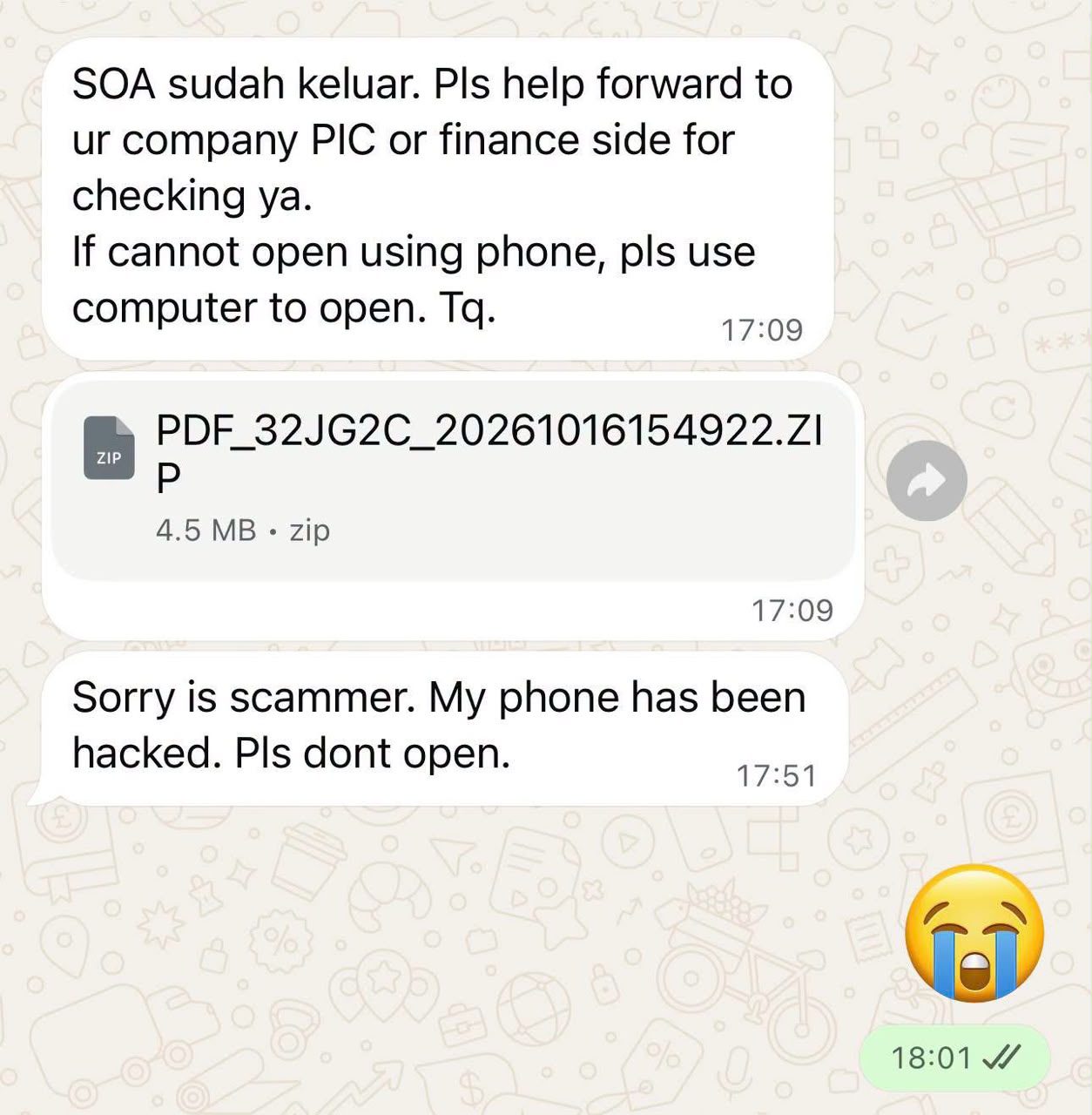
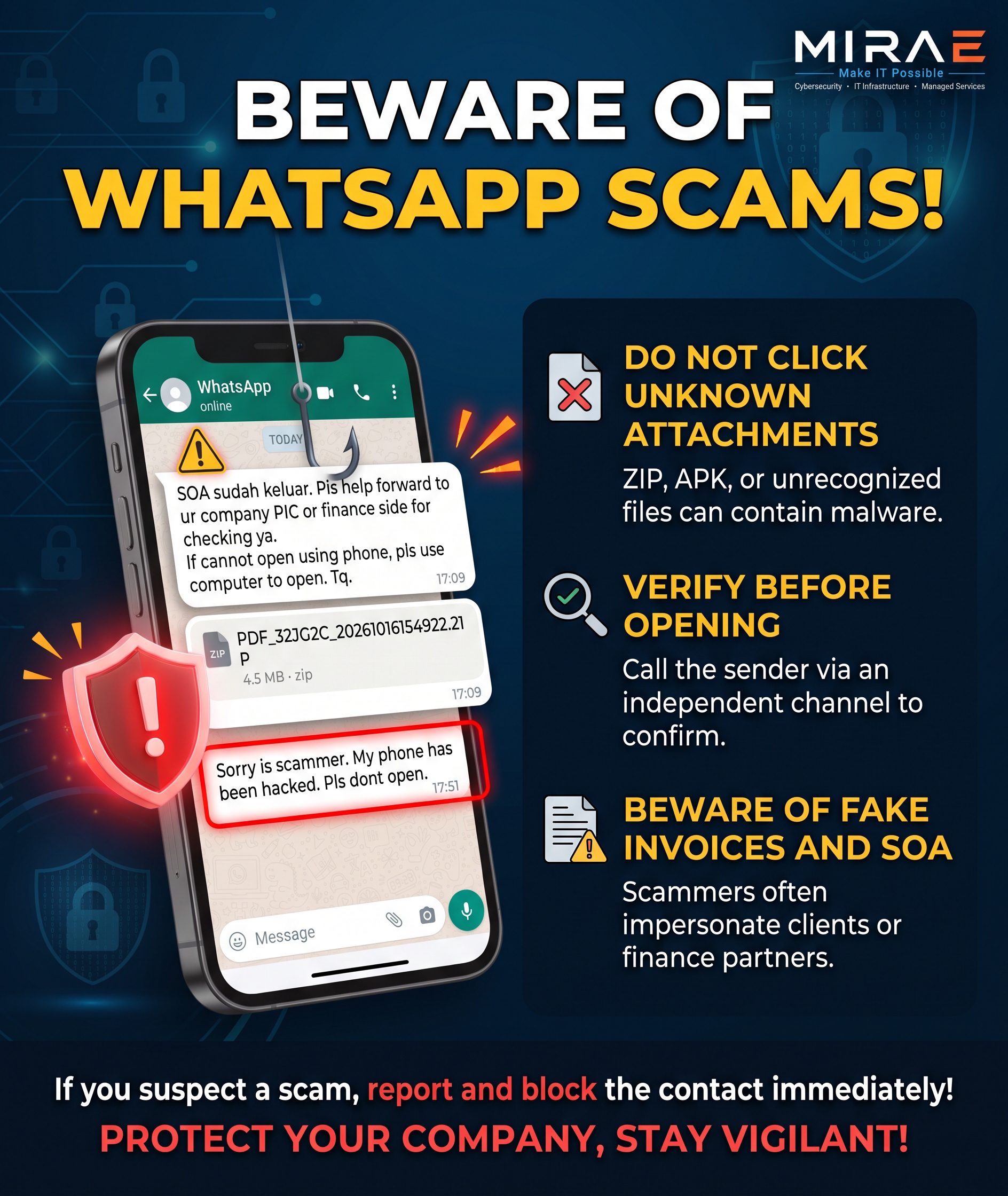
In Southeast Asia and Malaysia, messaging applications have become foundational tools for managing vendor operations, invoices, and business communications. However, this reliance creates an ideal pathway for cybercriminals to bypass conventional email filtering gateways. Recent campaigns show threat actors compromising legitimate WhatsApp accounts to distribute weaponized archives disguised as PDF invoices or SOA statements, specifically prompting users to open the attachments on PC workstations to breach corporate networks.
🎬 1-Minute Security Breakdown: Stopping weaponized archives on messaging channels
Industry Benchmarks & Deep Technical Intelligence
| Evaluation Metric | Modern Recommended Architecture (WhatsApp Malicious Archive & Account Hijacking Defense) | Legacy / Outdated Practice |
|---|---|---|
| Unknown Script Defense | Heuristic behavioral monitoring with automated sandbox quarantine | Signature-dependent matching; blind to zero-day compressed payloads |
| Verification Protocols | Enforced MFA and mandatory multi-channel secondary confirmation | No secondary checks; files executed directly from chat apps |
| Lateral Movement Containment | Sub-second network isolation of compromised nodes | Unrestricted network spread causing database-wide ransomware lockouts |
📌 Intelligence 1: Deconstructing Malicious Archive Vectors: Why Attackers Push Mobile Users to Desktop PCs
Recent intelligence indicates a significant pivot from email phishing to corporate messaging apps. While enterprise secure email gateways have matured, messaging channels lack equivalent automated perimeter inspection. Cybercriminals take advantage of this gap by weaponizing compressed archives masked with trusted filenames such as “PDF_Statement.ZIP”. The primary tactical objective is to convince the target to transfer the attachment to a Windows PC workstation. Because mobile operating systems enforce application sandboxing that prevents direct binary execution, threat actors deliberately include instructions stating that the file cannot be viewed on mobile devices. Once decompressed in a Windows office environment, embedded scripts immediately execute to establish Command-and-Control (C2) persistence, paving the way for lateral movement and ransomware deployment.
💡 Mira E Insight: Organizations must implement modern EDR solutions to monitor script execution at the operating system level, neutralizing malicious archives upon extraction regardless of their delivery vector. (Source: CyberSecurity Malaysia Threat Report)
📌 Intelligence 2: WhatsApp Hijacking in Southeast Asian Supply Chains: The Critical Need for Managed Governance
In Malaysia and regional business hubs, informal communication channels frequently handle official financial exchanges. Threat actors compromise vendor accounts through credential phishing, immediately leveraging established conversational history to distribute weaponized attachments. Because the sender appears genuine, standard security awareness often fails. Even if the compromised party regains control within an hour, the exposure window is sufficient to compromise accounting endpoints across multiple client organizations. Comprehensive defense demands moving beyond user vigilance toward structured managed IT frameworks, where secondary verification is mandatory for financial documents and corporate endpoints are protected against unverified process executions.
💡 Mira E Insight: Securing business continuity requires unifying endpoint policies, robust multi-factor verification, and immutable offline backup management under a proactive IT outsourcing strategy. (Source: APAC Supply Chain Cybersecurity Insights)
Enterprise Endpoint Security Architecture Overview
- Next-Gen Endpoint Detection & Response (EDR): Behavioral heuristics and immediate script sandboxing upon file extraction.
- Automated Anti-Ransomware Rollback: Instant execution termination and restoration of affected files during unauthorized access attempts.
- Network Micro-Segmentation: Isolation of user endpoints from core databases to prevent lateral movement.
- Corporate-Wide Multi-Factor Authentication (MFA): Enforcement across all business messaging and cloud systems.
- Immutable 3-2-1 Backup Implementation: Air-gapped backup protection to ensure rapid business recovery.
- Continuous Security Awareness & Managed Oversight: Simulated social engineering testing and continuous infrastructure monitoring.